Creating content with AI tools like ChatGPT, Midjourney, or Gemini?
Publer now lets you mark posts as AI-generated in the Composer and automatically send supported AI disclosure settings to social networks when your content is published. For agencies, social media managers, and creators sharing AI-generated images, videos, or virtual influencer content, that means no extra steps to disclose AI-generated content after scheduling. Previously, adding an AI label manually after publishing could interrupt an otherwise automated workflow. Now you can configure the disclosure before your post goes live.
As AI-generated content becomes more common, transparency matters more than ever. According to Clutch’s 2026 consumer research, nearly 90% of consumers believe it’s important for brands and creators to disclose AI-generated content on social media.
And if you regularly share AI-generated content, you can even set AI labeling as your default in Publer, so you don’t have to enable it every time.
TL;DR: AI-Generated Content Labels on Social Media
- What it does: Publer’s AI-generated setting lets you configure supported AI disclosures in the Composer before publishing or scheduling.
- Where it works: Eligible posts on TikTok, YouTube, Instagram, Facebook Pages, Threads, X, and Pinterest.
- Why it matters: AI labels help audiences recognize synthetic media and help creators follow applicable platform disclosure policies.
- For recurring AI content: Set AI labeling as your default, or customize supported settings for individual accounts.
- Audience expectations: According to Adobe’s 2026 Creators’ Toolkit Report, 85% of surveyed creators say audience expectations around AI disclosure are increasing or holding steady.
What Is an AI-Generated Content Label?
An AI-generated content label is a disclosure that informs audiences when content has been created or significantly modified using artificial intelligence. These labels can apply to AI-generated images, synthetic videos, artificial voices, virtual influencers, and other forms of AI-created or manipulated media. Depending on the social network, you might encounter different labels and disclosure settings. For example, Instagram and Facebook may show an AI info label, TikTok uses AI-generated content labeling, and YouTube asks creators to disclose altered or synthetic content. You might also encounter phrases such as Made with AI or AI modified. These are not interchangeable universal labels: each platform decides how disclosures appear and which content needs them.
Why Do AI-Generated Content Labels Matter?
Transparency and Audience Trust
AI-generated visuals, virtual personalities, and synthetic videos can look convincingly real. An AI disclosure helps viewers understand how the content was made without implying that every use of AI is deceptive. According to Adobe’s 2026 Creators’ Toolkit Report, 85% of creators say audience expectations around AI disclosure are increasing or holding steady, yet only 49% always or often disclose AI use. For brands and creators, clearly labeling AI content can support audience trust and avoid confusion about fabricated scenes, people, or events.
Platform Disclosure Policies
Social networks have different AI disclosure policies. TikTok and YouTube require creators to disclose certain realistic synthetic or altered content. Meta also has disclosure requirements for certain AI-generated or altered media, alongside labels that may be applied from technical signals. Other platforms have their own approaches to manipulated media.
An AI label is not a guarantee of policy or legal compliance. Creators still need to review each platform’s requirements, and a label does not make otherwise prohibited or misleading content acceptable. With Publer, you can configure supported AI disclosures before scheduling instead of adding them manually after publishing.
When Should You Label Content as AI-Generated?
Whether you need an AI label depends on the platform, the type of media, and how substantially AI changed it. Common examples include:
- AI-generated images and artwork: Synthetic portraits, photorealistic scenes, and illustrations. Some platforms require disclosure for realistic outputs; others may label additional AI media.
- AI-generated videos and audio: Fabricated footage, voice cloning, and realistic speech or events that never happened.
- Virtual influencers and synthetic characters: AI-created personalities whose content may appear to depict real people or experiences.
- AI-assisted edits and manipulated media: Material changes to a real person’s likeness, actions, or statements, or to real-world events.
By contrast, brainstorming a caption with AI, correcting grammar, or making minor visual adjustments generally does not trigger the same disclosure requirements. Check the specific network’s policy before publishing.
| Social Network | Label | When Is Disclosure Required? | Automatic Detection? | Impact & Risks |
|---|---|---|---|---|
| TikTok | AI-generated | Required for realistic AI-generated images, audio, or videos, including deepfakes and significantly altered people or events. | Yes: TikTok can automatically label content created with certain AI effects or identified through Content Credentials. | Labeling alone doesn’t affect reach. Unlabeled or misleading content may be removed. |
| Instagram, Facebook & Threads | AI info / AI content | Meta requires disclosure of certain realistic AI-generated video and audio. Other AI-generated media may receive labels through detection or disclosure. | Yes: Meta uses technical signals and metadata to identify and label AI-generated content. | Deceptive content may face restrictions. No universal reach penalty for labeling has been established. |
| YouTube | Altered or synthetic content / Made with AI | Required for realistic AI-generated or altered people, places, events, and AI-generated music that is the video’s main focus. | Yes: YouTube uses AI tools, metadata, and detection systems to identify and label AI-generated content. | Disclosure alone doesn’t hurt reach or monetization. Repeated nondisclosure may lead to removal or monetization penalties. |
| X | Made with AI | AI disclosure is available, but there’s no clearly established universal requirement to label all AI-generated posts. Deceptive synthetic media is restricted. | Not clearly documented. | Misleading manipulated content may be labeled, restricted, or removed. |
| AI modified | Pinterest allows creators to indicate when Pins contain AI-generated or modified content, but does not specify a universal disclosure requirement. | Yes: Pinterest uses metadata and AI detection technology to identify AI-generated content. | Users can choose to see fewer AI Pins in certain categories. No universal reach penalty has been established. | |
| Content Credentials | No universal AI disclosure requirement established for ordinary posts. Supported metadata can identify AI-generated or modified media. | Limited: LinkedIn identifies AI-generated content through embedded Content Credentials but cannot detect all AI-generated media. | Deceptive content may violate platform policies. |
Important: Platform detection is not a substitute for required creator disclosure. The presence of a label does not establish that a post will be penalized in reach, and no universal reach penalty should be assumed.
Publer’s AI labeling setting isn’t currently available for LinkedIn due to API limitations.
NEW: Mark Posts as AI-Generated Directly in Publer’s Composer
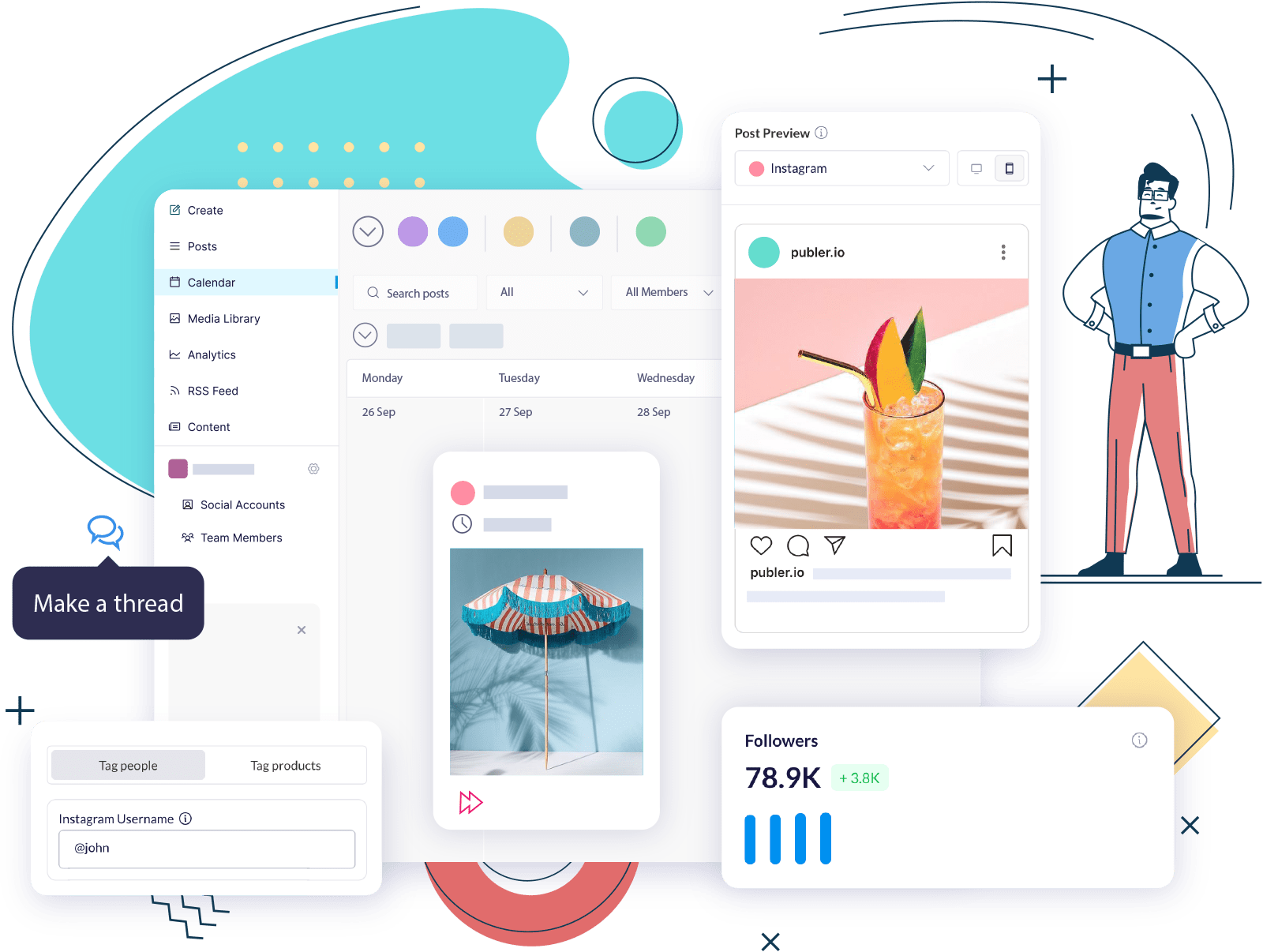
Looking for a social media scheduler that can mark posts as AI-generated? Publer brings supported AI disclosure settings into the same Composer where you create, customize, and schedule posts. Instead of adding an Instagram AI label, TikTok AI label, or other supported disclosure manually after publishing, you can set it up in advance as part of your normal scheduling workflow.
You can write captions, generate images, and maintain a consistent tone with Publer’s AI Assist and Brand Voices. Whether your media comes from Publer or an external tool such as ChatGPT, Midjourney, or Gemini, the disclosure setting can be configured in the Composer for supported posts.
How to Mark a Post as AI-Generated in Publer
Step 1: Create your post. Open Publer, go to Create, select your social accounts, and create your post as usual. Upload or generate your media, write your caption, and customize the content for each platform if needed.

Step 2: Enable AI disclosure. In the Composer, open post settings using the globe icon and enable the AI-generated content toggle.
Step 3: Customize by account. Publishing to multiple social accounts? Click “Customize” to access each account’s individual post settings and choose which supported accounts should have AI labeling enabled.
Step 4: Schedule or publish. Schedule social media posts as usual, or publish them immediately. Publer passes the supported disclosure setting when publishing content and each social network determines how the label appears.
You can also mark posts as AI-generated in Publer’s mobile app, whether you’re scheduling from your desk or on the go.

Set AI-Generated Content Labeling as Your Default
What if almost everything you publish is AI-generated? For virtual influencers, AI-focused creators, and agencies producing AI-generated campaigns, enabling the same disclosure setting for every post can become repetitive. That’s why Publer lets you enable AI-generated content labeling by default for each social account. Once enabled, the setting automatically applies to future posts, saving you the trouble of turning it on every time.

Which Social Networks and Post Types Support AI-Generated Content Labels in Publer?
Publer supports configuring AI-generated content disclosures for eligible post types across seven social networks:

Why Use Publer to Label AI-Generated Content?
Save time and simplify your workflow: Add supported AI-generated content labels before scheduling, without switching between platforms or manually updating posts after publishing.
Follow platform disclosure requirements: Manage AI labeling across supported social networks more easily while staying aligned with their individual disclosure policies.
Build audience trust: Be transparent about AI-generated or significantly altered content so your audience knows what they’re viewing.
Who Benefits Most from This Feature?
AI-generated content labeling isn’t just useful for occasional AI experiments. It can become an important part of everyday publishing workflows.
Agencies Managing Multiple Brands and Clients
Agencies often manage multiple clients with different content strategies, from scheduling AI-generated videos to publishing traditional content. With Publer, teams can customize AI disclosures for individual social accounts, making it easier to manage different labeling requirements across clients. Combined with Publer’s Workspaces and approval workflows, agencies can keep client content organized and consistent.
Creators Using AI Content Tools
From AI-generated images and videos to synthetic voices and AI-assisted edits, creators work with different types of content that may require different disclosures. Publer helps creators manage supported AI disclosures alongside their regular content, while the Ideas Board and Calendar View make planning and publishing easier.
Virtual Influencers and AI-Generated Personalities
Virtual influencers are digital personalities created using computer-generated imagery, AI, or a combination of technologies. Since these accounts often publish AI-generated portraits, synthetic characters, and videos, manually enabling disclosures for every post can become repetitive. With Publer’s default AI labeling option, teams can keep the setting enabled for future posts and maintain a more consistent publishing workflow.
Wrapping Up
AI-generated content is becoming a regular part of social media publishing, making transparency more important than ever. Understanding when to use an AI-generated content label helps creators build audience trust and follow platform disclosure policies.
With Publer, you can create, label, and schedule AI-generated content from one place. Customize AI disclosures for individual social accounts or set labeling as your default to simplify your publishing workflow.
Whether you’re creating content for your own accounts or managing AI-generated campaigns for clients, explore Publer’s plans to find the right setup for your needs.
Ready to simplify AI content scheduling?
FAQs
What Is an AI-Generated Content Label?
An AI-generated content label is a disclosure that informs audiences when images, videos, audio, or other media have been created or significantly altered using artificial intelligence. Labels vary by platform and may appear as “AI info,” “AI-generated,” or other notices.
Do I Have to Label AI-Generated Content on Social Media?
It depends on the platform and content. TikTok and YouTube require disclosure of certain realistic AI-generated or altered media. Other networks have their own policies. AI-assisted brainstorming or minor edits generally don’t require the same disclosures.
What Does “AI Info” Mean on Instagram?
“AI info” indicates that Instagram has received information suggesting content was created or modified using AI. The label may result from a creator’s disclosure or technical signals detected by Meta. It doesn’t necessarily mean the entire post was AI-generated.
Which Social Networks Does Publer Support for AI-Generated Content Labeling?
Publer supports AI-generated content labeling on TikTok, YouTube, Instagram, Facebook Pages, Threads, X, and Pinterest. How AI labels appear may vary depending on the social network.
Can I Schedule AI-Generated Posts With Publer?
Yes! With Publer, you can schedule AI-generated content and enable AI disclosure before publishing. You can also set AI labeling as your default for individual social accounts, so you don’t have to enable it for every post.
Can I Remove the AI Label After a Post Is Published?
That depends on the platform and how the label was applied. Some AI labels are generated automatically from metadata or platform detection and may not be removable manually. Publer helps you configure supported disclosures before publishing, but cannot override labels independently applied by social networks.

Tea Hysenshahaj